By 2026, job searching won’t be harder because there are fewer jobs. It’s harder because there’s more of everything else.
More listings. More platforms. More competition. More noise.
A single role can attract hundreds of applicants within hours. Job boards refresh constantly. Recruiters rely on automation to keep up. Candidates are expected to move fast, stay organized, and somehow still sound thoughtful and human in every application.
That pressure is what pulled AI into the job search conversation. Not as a shortcut, and definitely not as a replacement for effort, but as infrastructure.
In the same way calendars replaced sticky notes and email replaced fax, AI is quietly becoming the system underneath how modern job searches run.
By 2026, the question is no longer whether to use AI. It’s how to use it without losing agency.
Over the past year, I’ve tested a wide range of AI-powered job search tools. Some are built for speed. Others focus on organization. A few attempt to do everything at once. What became clear very quickly is that no single tool is perfect. Each one solves a specific problem, and almost all introduce new trade-offs along the way.
The goal isn’t to find the “best” AI tool.
It’s to build a system that works without getting in your way.
How AI Actually Fits Into the Modern Job Search
One misconception I had early on was that AI job search tools “do the work for you.” After spending time inside multiple platforms, it’s clear they don’t, and the good ones shouldn’t.
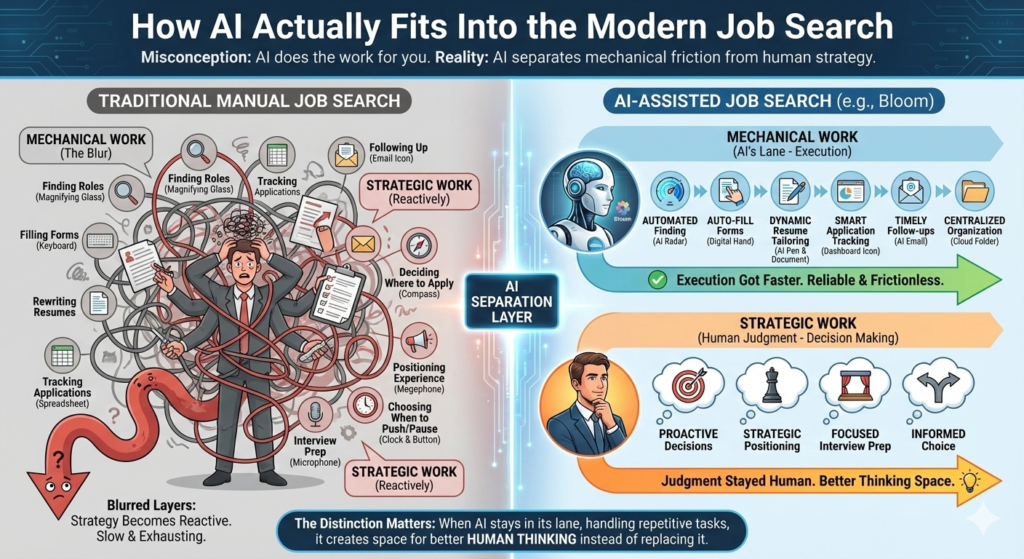
Job searching has always had two distinct layers.
The first is mechanical work: finding roles, filling forms, rewriting resumes, tracking applications, following up, and staying organized.
The second is strategic work: deciding where to apply, positioning your experience, preparing for interviews, and choosing when to push or pause.
Manual job searches blur these layers. You spend so much time clicking, copying, and context-switching that strategy becomes reactive. AI-assisted workflows separate them.
The strongest tools consistently removed mechanical friction without touching decision-making. Judgment stayed human. Execution got faster.
This is where platforms like Bloom started to feel less like point tools and more like systems. Not because they removed choice, but because they reliably handled the repetitive parts of the process. That distinction matters. When AI stays in its lane, it creates space for better thinking instead of replacing it.
The AI Job Search Stack in 2026
Most people don’t need “the best AI tool.”
They need the right combination of tools that handle different parts of the process.
Here’s how the ecosystem actually breaks down in 2026.
1. AI Job Discovery & Search Automation
Job discovery is where most job searches quietly fail.
Traditional platforms like LinkedIn, Indeed, and Google Jobs still dominate visibility, but they rely on constant manual checking. You see a lot, but you also miss a lot, especially roles posted directly on company career pages or niche boards.
Curated platforms reduce noise, particularly for startup or engineering roles, but they often cap volume or skew toward specific industries.
Some newer tools combine discovery with downstream actions like resume customization or applications. In testing, the experience varied widely. Some felt opaque, while others, like Bloom and Jobright, made it clearer what was happening behind the scenes. That transparency mattered, especially when applying at scale.
When discovery feels like a black box, trust erodes quickly.
2. Resume Optimization & ATS Alignment Tools
Resume tools are often misunderstood as resume writers. In practice, the best ones act more like diagnostics.
Platforms like Jobscan, Resume Worded, and Rezi analyze resumes against job descriptions to highlight keyword gaps and ATS alignment issues. Used carefully, they save time and reduce guesswork, especially for early-career candidates.
The risk is over-optimization. Blindly following suggestions can flatten personality and strip nuance from real experience.
Several auto-apply platforms, including Jobright, Aiapply, and Bloom (even in its free tier), now include resume optimization inside the application flow. That integration matters. When feedback shows up in context, it’s easier to make intentional edits rather than wholesale rewrites.
AI should refine your resume, not overwrite your voice.
3. Cover Letter Generation Assistants
Cover letter tools have improved dramatically, but they’re still drafts, not final answers.
Tools like Kickresume, CoverDoc, and general-purpose AI writers help overcome blank-page paralysis and generate structure quickly. Without edits, the outputs often sound generic or overly polished.
What stood out in better implementations was restraint. Platforms that treat cover letters as accelerators rather than mandatory steps tend to preserve more of the applicant’s voice.
Ai apply and Jobright’s approach, for example, positioned cover letters as optional leverage rather than default automation. That framing encouraged review instead of blind submission.
4. Application Autofill & Submission Helpers
Auto-apply remains controversial, and for good reason. Applying everywhere faster doesn’t automatically improve outcomes.
The difference lies in implementation.
Some tools optimize purely for volume. Eg. Lazyapply. Truly built for lazy job seekers who don’t want to be bothered with applications at all. While this could be scary, it really helps with spray-and-pray users.
Others introduce checks, reviews, and context before submission. Bloom’s smart application flow stood out here. It pre-filled known details, surfaced only missing fields, and allowed review before submission. It didn’t feel like a spray-and-pray machine.
Used selectively, this kind of automation protects energy without sacrificing relevance. Used blindly, it still carries risk. The tool gives leverage, not absolution.
5. Job Tracking & Pipeline Management Tools
Tracking sounds boring until you lose momentum.
Most job seekers start with spreadsheets. That works for about ten applications. After that, things quietly break. Follow-ups get missed. Recruiter replies get buried. You forgot which resume version you used.
Tools like Huntr and Teal focus purely on tracking and do it well. They offer structure without interfering with how you apply.
Other platforms integrate tracking directly into the application flow. This reduces friction but raises a different challenge: trust. You need visibility without feeling like decisions are being hidden from you.
Good tracking feels invisible. Bad tracking feels like homework.
6. Interview Preparation & Simulation Tools
Interview prep tools are confidence tools first, performance tools second.
Platforms like Interviewing.io, Pramp, and Yoodli help candidates practice structure, pacing, and delivery. For technical roles, mock interviews can be transformative, especially for early-career engineers.
AI-based simulators excel at repetition and pattern recognition. They’re less effective at nuance, tone shifts, or unexpected follow-ups. I was truly impressed with Lockedin AI. It still has a long way to go, but what a find.
The strongest results came when prep was tied to real applications. Practicing generic questions helps. Practicing questions linked to roles you’ve actually applied for helps more.
7. Skills Gap & Career Path Analysis Tools
Career analysis tools think long-term in a short-term job market.
Platforms like LinkedIn Career Explorer and Eightfold analyze backgrounds and suggest adjacent roles or skills to develop. These insights are valuable, especially when direction feels unclear.
The challenge is timing. During an active job search, insight without immediate action can feel frustrating.
Some platforms integrate this feedback loop directly into job matching. Ai Apply’s & Bloom’s job fit scores surfaced skill gaps alongside active applications, making the insight actionable rather than abstract.
8. Salary Benchmarking & Offer Comparison Tools
Salary tools shape mindset as much as decisions.
Glassdoor, Levels. Fyi, Blind and similar platforms provide useful benchmarks, especially in tech. Used well, they anchor expectations. Used poorly, they inflate them.
The strongest negotiators treated these tools as context, not truth. Market data works best when paired with role scope, company stage, and growth potential.
9. Networking & Outreach Drafting Tools
Outreach is where automation can help or hurt the most.
Tools like Wonsulting AI, Lavender, and general-purpose AI writers reduce friction and speed up drafting. But volume without intention is obvious, especially to hiring managers.
The best outreach workflows used AI as a starting point, not a sender. Drafts were edited. Context was added. Tone was adjusted.
Some platforms now track outreach alongside applications, including Bloom, Jobright, and Aiapply. Seeing response patterns changed behavior. Automation felt supportive rather than spammy when relevance was prioritized over volume.
10. End-to-End Job Search Platforms
A small number of platforms aim to unify discovery, optimization, application, and tracking. When done right, they reduce fragmentation and tool fatigue. When done poorly, they introduce opacity.
Trust becomes critical here.
In testing, no platform was perfect.
- Jobright lacked auto-apply.
- Aiapply’s discovery felt limited.
- Bloom’s outreach features are still in Beta.
- Lazyapply is just spray and pray.
- Teal leaned heavily toward resume optimization.
- Simplify tried to do it all but struggled with accuracy.
- Newer players like Massive show promise but remain early.
What worked best across platforms was a shared philosophy:
- Clear visibility into what the AI is doing,
- Control over when automation runs,
- And feedback loops that improve decisions over time.
Bloom consistently landed closer to that balance. It didn’t feel like handing over the job search. It felt like working with a capable assistant that stayed in its lane. Ai Apply comes close second.
The Real Future of Job Search: AI + Judgment
AI isn’t a passing trend in hiring. It’s becoming standard infrastructure on both sides of the market. Recruiters automate screening and communication. Job seekers use AI job finder tools to keep pace.
But AI doesn’t replace strategy. It can’t choose long-term goals, negotiate offers, or build genuine rapport. What it can do is remove friction so those moments get the attention they deserve.
In 2026, AI is the baseline. Human judgment is the differentiator.
The tools didn’t make job searching easier. They made inefficiency more visible.
The advantage goes to candidates who use AI with intention, restraint, and clarity. Not to apply everywhere faster, but to apply better, with less noise and more focus.
That’s what modern job searching actually looks like now.
Used correctly, AI doesn’t replace effort. It makes effort count.
